With the massive housing boom across New Braunfels and the Texas Hill Country, thousands of young trees are being planted every month. But rapid development often means rushed tree planting—and it’s leaving homeowners with a ticking time bomb buried just beneath the soil.
One of the most common—and devastating—issues our professional arborists see in brand-new subdivisions is a condition called girdling roots. If left unchecked, this entirely preventable problem will slowly choke your beautiful young oak or elm to death, leaving you with a dead landscape and the hefty bill for a premature tree removal.
The Nursery Pot Trap
The problem starts long before the tree ever reaches your yard. When young trees sit in black plastic nursery pots for too long, their roots hit the plastic wall and begin to circle around the root ball.
When volume-focused landscapers install these trees, they often take them straight out of the pot and drop them into a hole without breaking up or "teasing" the root ball. To make matters worse, they regularly plant the tree too deep, covering up the natural flare of the trunk with heavy clay and mulch.
As the tree grows, those circling roots thicken and harden, wrapping around the main trunk like a python. This cuts off the vascular tissue, choking the flow of water and nutrients from the canopy.
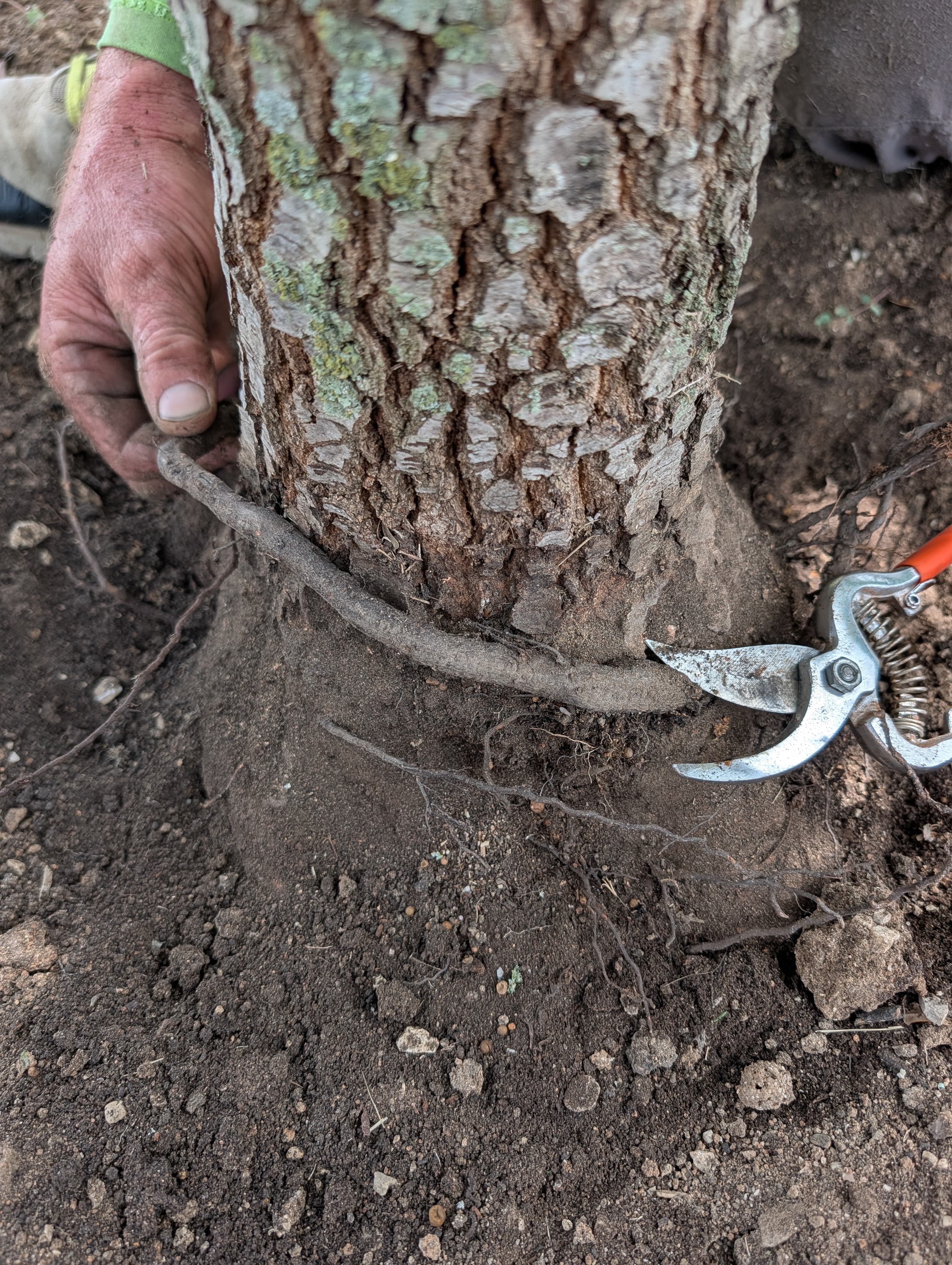
The Chokehold: Here, our team carefully excavated the dirt around a young tree to expose the hidden girdling root. Notice how it wraps tightly against the bark, strangling the trunk's vascular system.
How to Spot the Danger
The good news? You don't need to be a professional tree service to spot a girdling root on a young tree. Look at where your tree meets the grass.
- The "Telephone Pole" Look: A healthy tree should widen at the base where the roots meet the trunk (this is called the root flare). If your tree goes straight into the ground like a wooden telephone pole, it is planted too deep.
- Flattened Bark: If you see one side of the trunk looking inexplicably flat or sunken in, there is likely a root squeezing it directly underneath the dirt.
- Early Fall Colors: If your young tree is dropping leaves in July or turning yellow months before the rest of the neighborhood, it's screaming for water because its vascular system is being choked off.
The DIY Fix: Snipping the Threat
If you catch it early enough on a newly planted tree, you can handle this yourself. Put on some gloves and gently dig away the top few inches of dirt and mulch right at the base of the trunk until you expose the root flare.
If you see a woody root crossing over the trunk instead of growing outward into the yard, grab a sharp pair of bypass pruners. Carefully snip the root in two places to remove a small chunk of it, ensuring the ends won't graft back together. Be incredibly careful not to gouge the actual bark of the tree trunk while doing this!
When to Call the Pros
If the girdling root is thicker than your thumb, deeply embedded into the trunk, or the tree is already showing severe signs of canopy dieback, put down the pruners. Don't risk permanent damage—let our professional tree service handle the excavation.